Posts

Should I Buy That Laser? #PACPearls

Image
PAC Pearls from the Women’s Dermatologic Society The cost of technology has risen substantially in the last few years. Making smart decisions about adding technology to your practice is critical. Many dermatologists find this decision stressful as a wrong choice can be a burden to your practice for years to come. As dermatologists, we are bombarded with claims, some legitimate and some less so, of fabulous results and “returns on investment”. Technology companies are adept at selling and it is up to us to have the tools to decide the best choice for our practice. This month we are curating tips from the WDS Practice Advisory Committee (PAC) on how to evaluate the best possible technology option for your practice and when to walk away. Once you have decided upon the “perfect” device, have an honest assessment of your practice and never be in a rush to purchase! Understand your Clientele No matter what the newest hottest device may be, do your own homework before starting...

Managing Your Time in a Digital World

By Lori Fiessinger, MD I’ve learned many valuable lessons in my first year of practice, but none have been more important than time management. Physician burn out is a real problem that we all will likely face at one time or another. I’ve attended many lectures on burn out, and while I did feel solidarity in hearing that others were having similar experiences, I was always left wanting more practical tips on how to avoid being overwhelmed by professional and personal obligations. As women in medicine, we are incredibly busy. There are a limited number of hours in the day, and making the most of those hours is key.  >> Read the Full Editorial Productivity Emails Helpful Apps

IJWD July 2019 Issue Now Available

Image
The  July issue of the International Journal of Women's Dermatology is now available online. Review the full table of contents, access the Women's Health Highlight and Art of Prevention signature articles, and download the Patient Page resources on the new IJWD website: www.wdsijwd.org . WOMEN'S HEALTH HIGHLIGHT   Clinical considerations for the management of psoriasis in women Alice B. Gottlieb, Caitriona Ryan, Jenny E. Murase Read all Women's Health Highlights PATIENT PAGE The Patient Page is a concise, informative sheet that Health Care Providers can download, print and provide to their patients to prompt them to ask relevant questions and begin focused doctor/ patient dialog.  Psoriasis Management in Women Alice B.Gottlie, Caitriona Ryan, Jenny E.Murase FULL TABLE OF CONTENTS Clinical considerations for the management of psoriasis in women Alice B. Gottlieb, Caitriona Ryan, Jenny E. Murase Introduction to The Art of Preventio...

Photography in the Clinic #PACPearls

Image
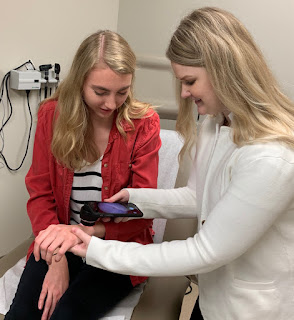
The WDS Practice Advisory Committee (PAC) shares dermatology photography tips including how to take quality photos and save time, before and after photography, dermoscopy and more. Dermoscopic Photography I find it very helpful to monitor pigmented lesions for changes using dermoscopic photography. In order to do this quickly, I have a phone case that is magnetized to hold my dermatoscope in place. Both my dermatoscope and the case are from DermLite. Using an app for EPIC, my photographs can be directly uploaded into the patient's chart for future use. I find this system to be very quick and efficient.  Taking dermoscopic photographs of things that I biopsy has also improved my own knowledge. I review photographs when dermpath comes back to see if there are any features that I can learn from for a particular diagnosis. For anyone who teaches residents, having a library of dermoscopic images can also improve residency training. - Lori Fiessinger, ...

The Art of Chemical Peeling

Opinion Article By Seaver Soon, MD A resurgence of interest in chemical peeling is currently taking place in the dermatology community for its time-tested efficacy and safety in treating cosmetic and medical concerns at a cost comparison without peer. Like many procedures in dermatology, there is an art to the technique, which is learned through direct hands-on instruction focusing on the pre-peel preparatory regimen, application techniques to obtain the appropriate peel penetrations for different indications, assessment of clinical endpoints, as well as post-operative instructions.  Hands-on instruction, and the current state of the field, is available through such societies as the American Society for Dermatology Surgery and the International Peeling Society. >> Read the Full Editorial Definition Preparatory Regimen Post-Procedure Care Superficial Peels Medium Depth Peel  Deep Chemical Peels Complications Conclusion

Avoiding the MIPS Penalty in 2019 #PACPearls

Image
By Dr. Mark Kaufmann The bar has been raised. The amount of MIPS points required to be exempted from the 7% penalty in 2021 (for performance year 2019), is DOUBLE what it was last year. Instead of 15 MIPS points, you now need to get 30 MIPS points. With a little more effort, there is still a way to avoid the MIPS penalty in 2019, and while it’s still possible to do this without using a registry OR an EHR, both of them would make it a lot easier. Here’s how to get it done: If you are a small (fewer than 15 clinicians) practice, each clinician needs to complete five measures on at least one patient. I still recommend that each clinician complete five measures on more than one patient. Any combination of measures will do, and five will give you 15.75 points. In order to get up to 30 MIPS points, you will also need to do a High Weighted Improvement Activity (IA). You can choose any of the high weighted IAs from the 2019 Improvement Activities List , and if you want to do it wit...

Career Corner: Deciding on a Career Path - Academics vs Private Equity vs Starting Your Own Practice

The WDS Young Physicians Committee shares their insight and experiences from their first year on the job including: >> Read the Full Article How did you choose your career path? What advice do you have about choosing a career path? Did someone help guide your path? If you were in private practice previously and now private equity, what pros/cons are there to each? If you are considering join a private equity practice, what are important things to know?